
A student can want an education and still find the route into school hard to reach. Distress may show up the night before, at the bedroom door, beside the bus, in the parking lot, at classroom entry or after the student has held things together all day. Attendance alone does not show where access is breaking down.
Autistic school attendance distress is a useful description, not a diagnosis. School-related anxiety may be one contributor. Other possibilities include pain or illness, disrupted sleep, bullying or discrimination, sensory load, communication barriers, a learning mismatch, unpredictable changes, transport difficulties or several factors together. The answer varies by student and can change over time.
The goal of this guide is not to make a child or teen push through every part of the day. It is to help families and school teams locate the difficult part of the route, protect the student’s dignity and make one practical access change. Attendance rules, accommodation processes and available services vary by school board and jurisdiction. This is general information, not legal, medical or individualized educational advice.
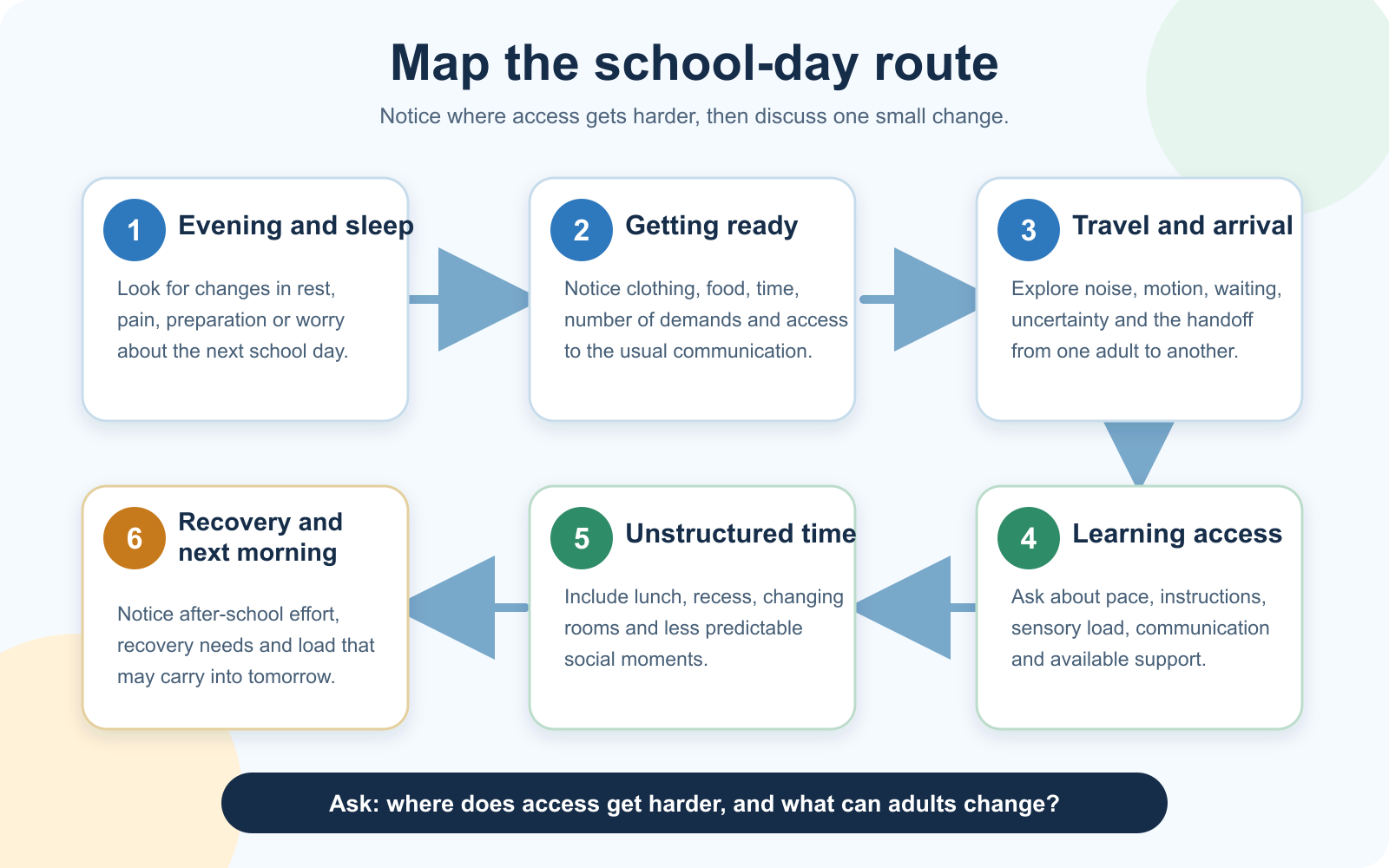
Map the route, not the child
Start with the school day as a sequence of places, transitions and demands. A student who misses the whole day may be able to tell adults about only one difficult part. Another student may attend regularly while using enormous effort that becomes visible only at home. Invite input through the student’s preferred communication, including speech, AAC, typing, gesture, pictures, written choices or support from a trusted person.
A 2024 scoping review of school absenteeism in autistic students found varied definitions, contexts and contributing factors, with limited evidence about targeted interventions. Possible factors included bullying and insufficient accommodation alongside health and mental health conditions. This supports investigating the individual route instead of prescribing one solution.
Evening and sleep set the first part of the route
Look at when the next school day begins to feel difficult. Homework may extend late. A student may be preparing for an uncertain timetable, a social demand or a morning transition. Sleep may also be affected by noise, discomfort, medication, worry or a different sleep pattern. NICE guidance recommends considering sleep patterns, the sleep environment, possible physical discomfort, medication effects and problems at school when an autistic child or teen has sleep difficulties.
Keep the first route note small: bedtime and waking pattern, anything the student communicated, what was different about the coming day and whether pain or illness needs qualified attention. Do not turn a late bedtime into a character judgment. A family might ask the school for tomorrow’s first activity, a schedule change or a known contact before choosing what to adjust.
Fictional example: A teen types “presentation tomorrow” while staying awake later than usual. The family shares the message through the approved school channel. The teacher offers a written choice of presentation formats already available under the student’s plan. This does not prove the presentation caused the sleep change, but it gives the team a specific part of the route to discuss.
Getting ready and leaving can hold several demands at once
“Will not leave” can hide many separate tasks: waking, dressing, eating, finding materials, tolerating clothing, switching away from a preferred activity, hearing time pressure and crossing the doorway. Map where movement slows or distress rises. Ask whether the student can communicate a pause, help, pain, a clothing problem or uncertainty about what happens next.
Try changing one route condition that the student accepts. Possibilities include laying out two clothing choices, packing earlier, reducing spoken reminders, showing only the next step or having the school contact available before departure. The change is an access option, not a reward the student must earn.
Fictional example: A learner gets dressed and packs a bag, then sits on the floor when shoes appear. Instead of adding repeated countdowns, the caregiver offers the established “help,” “different” and “not yet” choices. The learner selects “different.” The family notes the response and checks the shoe fit rather than assuming the whole school day is the problem.
Travel and arrival are more than transportation
The bus, car, walking route and school entrance each have sensory, timing and social demands. A delayed vehicle, crowded bus, loud drop-off area, unfamiliar driver or unclear handoff may change access. The first school interaction can matter too: where the student enters, who greets them, what language is used and whether there is time to settle.
Useful route adjustments might include a consistent entrance, a named arrival contact, a visual of the first destination, permission to enter away from the busiest flow or a clear plan for late arrival. A shortened entry may fit one student and not another. Families should confirm transportation and attendance procedures with the school or board rather than inventing an informal arrangement that staff cannot safely follow.
Being in the building is not the same as having class access
A student may reach school and still struggle to enter a particular room, begin work, use the available response method or manage accumulated sound and uncertainty. Consider task clarity, language load, reading and writing demands, sensory conditions, seating, group work, substitute staff, access to AAC and whether a break can be requested without public attention.
The Autism CRC inclusive education guidance centres student wellbeing, belonging, collaboration, teaching practice and the physical environment. In Ontario, the Human Rights Commission’s accessible education policy emphasizes dignity, individualization, inclusion and meaningful dialogue in accommodation. This article is not legal advice, but those principles support asking what needs to change in the learning environment.
Fictional example: A student reaches math class but stays near the doorway on days when instructions are delivered only aloud. The teacher provides the same first step in writing and identifies a quiet starting seat. The team watches whether that route is usable while remaining open to other explanations and supports.
Lunch, recess and changeovers need their own route
Unstructured time is still full of expectations. Noise, food smells, crowded movement, peer uncertainty, bullying, changing supervision and the need to find a safe place can all matter. A student who attends morning classes and leaves before lunch may need the lunch route examined, not a lecture about the value of the afternoon.
Map where the student can go, how they reach it, who is available, how they communicate a concern and what happens if the usual adult is absent. Bullying, racism, homophobia, transphobia, ableism or another safety concern requires an active school response. Do not frame an unsafe environment as anxiety the student must simply learn to tolerate.
Recovery and the next-day route belong on the map
Ask what the school day appears to cost. A student may need quiet, sleep, movement, food, reduced conversation or time with a familiar interest. Recovery needs differ and do not establish a cause. They can still show that the team should consider the full load, not only whether the student crossed the school door.
For the next day, decide what information is actually useful. A brief message might name the difficult route point, the support that was available and the one change being tried. Avoid a long nightly review if the student does not want it. Build in a way for the student to correct the adults’ understanding later.
Create an accessible one-page route map
Use plain language and the student’s communication style. For autistic school attendance distress, this route map is not a scorecard. It can be a page, a set of cards or an approved digital record.
- Route point
- Name the exact place or transition: evening schedule, doorway, bus, entrance, first class, lunch or recovery.
- What the student communicates
- Record words, AAC, typing, gesture, choices or a request not to discuss it.
- Access already available
- List the communication, sensory, learning and relationship supports that should be present.
- One route change
- Choose a small environmental, timing, task or handoff adjustment the student can accept.
- Named school contact
- Identify who can confirm the change and what happens when that person is away.
- Review point
- Set a short date to ask the student what fit, what did not and what needs qualified follow-up.
If the route change belongs in an IEP or accommodation process, the earlier Ontario IEP meeting guide can help turn it into a specific support with an owner and review date. The Sage’s World educator page also explains why a contextual observation can support discussion but cannot act as a formal assessment.
Understand the current Ontario attendance rules
Ontario’s Policy/Program Memorandum 169 says that when a student cannot attend because of a mental health concern, the absence must be excused under the Education Act provision for sickness or other unavoidable cause. It also explains that a principal may temporarily excuse attendance on written request in circumstances described by the policy when supporting documentation is unavailable. The rule concerns the reason a student cannot attend. It does not mean every attendance difficulty, or an autism diagnosis by itself, is automatically recorded as excused. Ask the principal or board how the current process applies to the student.
Starting in 2026-27, Ontario says attendance and participation count for 15% of final grades in Grades 9 and 10 and 10% in Grades 11 and 12. The same student assessment page states that excused absences do not negatively affect a student’s mark. The province’s 2026-27 enrolment register instructions govern how boards record attendance. These rules govern records, not individual support.
School Mental Health Ontario’s current parent resource notes that students can avoid school for different reasons, including peer concerns, bullying and discrimination. It lists a school-team meeting, possible schedule or academic changes and a professionally supported graduated entry among options to discuss. These are possibilities, not promises or universal steps. Anxiety-focused advice should not be applied automatically when the source may instead involve pain, sleep, sensory access, learning, communication or transportation.
Keep route information private and purposeful
Share only what authorized people need to provide support. Use the board’s approved system, not a broad group chat. The Information and Privacy Commissioner of Ontario’s Digital Privacy Charter for Ontario Schools promotes strong protections in digital education tools and services. Keep names, diagnoses, school records, contact details and identifiable route notes out of general AI tools and drafts.
Bring in qualified and urgent help when needed
Seek qualified medical care for possible pain, illness, significant sleep change or medication concerns. Ask the school about its mental health team and referral pathway when distress is persistent or substantially affecting daily life. If someone is in immediate danger or needs urgent medical support, call 911. For suicide-related concern in Canada, call or text 9-8-8. Youth can also contact Kids Help Phone at 1-800-668-6868 or text CONNECT to 686868, as listed by the Government of Canada.
Where Sage’s World can fit, gently
Sage’s World is an educational and organizational tool, not therapy, diagnosis, formal assessment, medical or legal advice, an attendance system or a replacement for professionals. In a calm planning moment, familiar words, a visual schedule or social story might clarify one route point. An adult might record a short learning observation without making attendance a game or demand.
The How It Works page explains the goal, practice and observation loop. Privacy & Data describes family controls and optional services. Core learning does not require AI. Keep school and health records out of optional AI tools.
Sources and Further Reading
- Ontario Ministry of Education, Policy/Program Memorandum 169: Student Mental Health
- Ontario Ministry of Education, Student assessment, evaluations and report cards
- Ontario Ministry of Education, 2026-27 Enrolment register instructions
- School Mental Health Ontario, Supporting Your Child with School-Related Stress and Anxiety
- Ontario Human Rights Commission, Policy on accessible education for students with disabilities
- Nordin and colleagues, School absenteeism in autistic children and adolescents: a scoping review
- NICE, Autism spectrum disorder in under 19s: support and management
- Autism CRC, National Guidance for best practice in inclusive education for autistic students
- Information and Privacy Commissioner of Ontario, Digital Privacy Charter for Ontario Schools
- Government of Canada, Mental health support: Get help
Sources, links and time-sensitive Ontario guidance were checked August 25, 2026.
General-information disclaimer: This article provides general educational information and lived perspective. It is not therapy, diagnosis, formal assessment, medical advice, legal advice, emergency instruction or an individualized attendance or accommodation plan. Needs, policies and services vary. Work with the autistic student, family, school board and qualified professionals for individual decisions.