
A practical Ontario IEP meeting checklist for turning strengths, observations and access needs into a clearer plan with learner input, named actions and review dates.

Skip to main content

Ontario practical guide

Ontario IEP Meeting Checklist: Build a Plan the Whole Team Can Use

Notebook and pens on a table in front of a blurred meeting group and speaker
Photo by maks_d on Unsplash. Free to use under the Unsplash License.

An IEP meeting can feel crowded before anyone enters the room. There may be reports, unfamiliar terms, several professionals and more concerns than one conversation can hold. A short preparation page can help everyone focus on what the learner needs to access school, what adults will do next and when the plan will be reviewed.

This guide is for Ontario families and school teams. The practical questions can also help educators, respite workers and community support workers prepare for collaborative planning, but rules and names vary by province, territory, school board and setting. It is general information, not legal advice, educational placement advice or an individualized recommendation.

Autistic people use different language for themselves. This article uses identity-first wording while respecting person-first preferences. Invite the learner to lead on language and participation whenever possible.

Know what an Ontario IEP is, and what it is not

The Ontario Ministry of Education describes an Individual Education Plan, or IEP, as a written plan of the special education programs, accommodations and services a school board will provide. It is based on the learner’s strengths, needs and ways of learning and demonstrating learning.

An IEP is required for a student identified as an exceptional pupil through an Identification, Placement and Review Committee, or IPRC. A board may also develop an IEP for a student who has not been formally identified by an IPRC. That distinction matters because an autism diagnosis, an IPRC decision and an IEP are related concepts, but they are not the same process.

Ontario Regulation 181/98 requires the principal to ensure consultation with the parent and with the student when the student is 16 or older. For a student placed through the IPRC process, the regulation says the plan is to be completed within 30 school days after placement. That is not 30 calendar days after a parent asks for a meeting. The regulation does not require one particular meeting format.

Ontario’s parent guide says schools should review the IEP at least once every reporting period. The ministry’s longer special education guide calls it a working document. Supports and learning expectations can be revised when new information shows that a change is needed.

Use CLEAR to prepare for the conversation

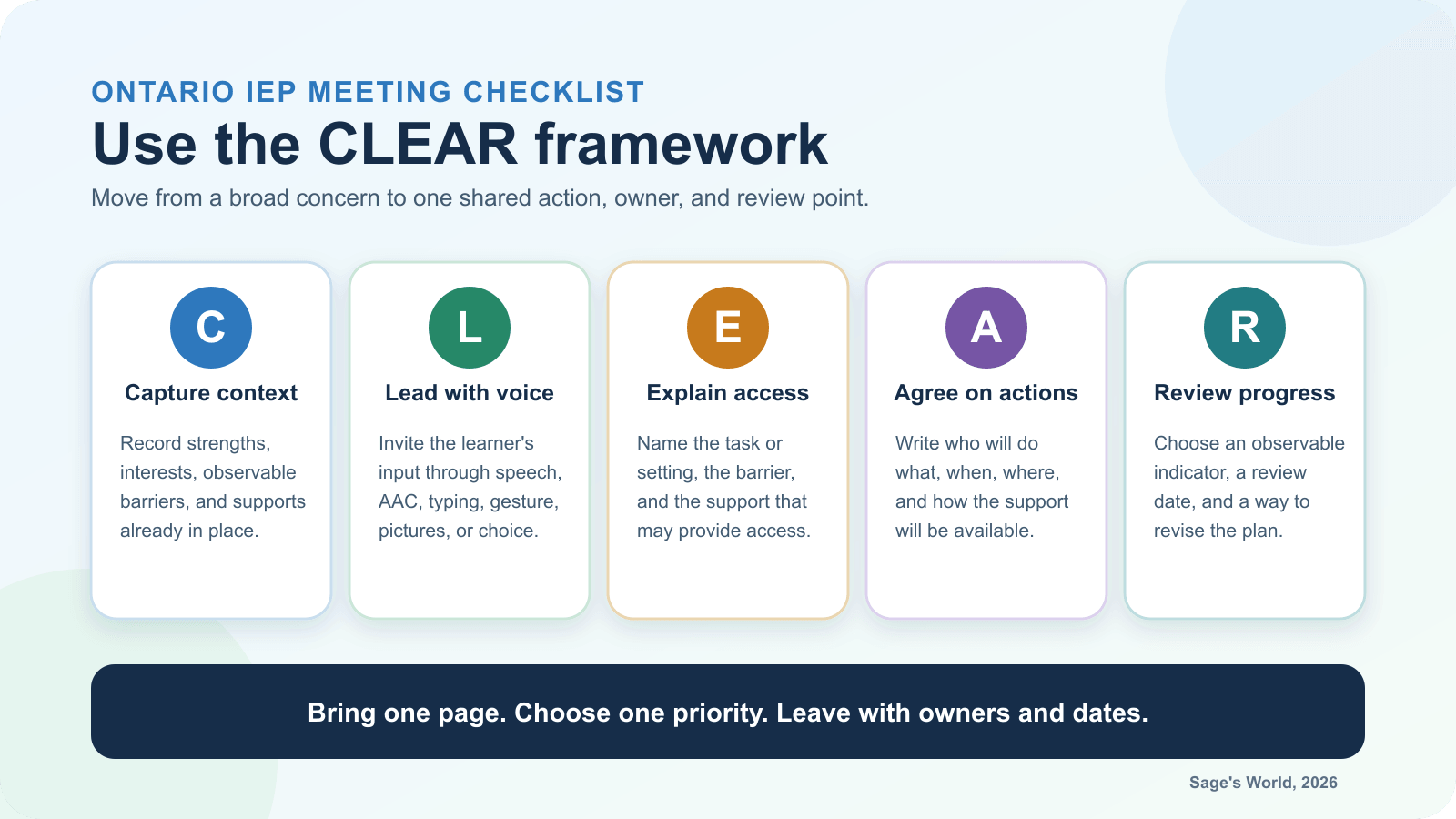
CLEAR is a simple preparation framework, not an official Ontario form. It helps move a broad concern toward a shared next step.

C

Capture context

Note strengths, interests, observable barriers and supports already available.

L

Lead with learner voice

Invite input through speech, AAC, typing, gesture, pictures, signs or supported choices.

E

Explain access needs

Name the task or setting, the barrier and a support that may provide access.

A

Agree on actions

Record who will do what, when, where and how the support will be available.

R

Review observable progress

Choose an indicator, a review point and a way to adjust the plan.

Capture context without turning interpretation into fact

Begin with what was directly seen, heard or communicated. “During a whole-class verbal instruction, the learner did not begin the task. When the first step was also shown in writing, the learner selected a response and started.” Those are observations. “Was unmotivated” is an interpretation. It may hide a barrier related to language processing, uncertainty, sensory load, communication access or something else.

A short, context-rich note can help, but the meeting is not a contest to produce the largest file. Bring only what supports the decision in front of the team. The earlier Sage’s World guide on writing useful learning observations can help you separate what happened from what it might mean.

Lead with learner voice in an accessible way

Ontario guidance requires consultation with students aged 16 or older and encourages involvement of any student to the degree possible. Participation does not have to mean speaking live in a meeting. A learner might choose a photo, rate parts of the school day, type a sentence, use AAC, point to options, record a message or ask a trusted person to share their words.

Ask low-pressure questions: What helps you know what happens next? Where is it easiest to think? How do you want to ask for a pause? What part of school matters to you right now? A “not sure” or a choice not to participate in one format is also information about how the process should be designed.

A person marking boxes on a handwritten checklist in a notebook
Photo by Jakub Żerdzicki on Unsplash. Free to use under the Unsplash License.

Bring a one-page brief, not a private data dump

A one-page brief keeps the meeting usable. It can be handwritten or created in the school board’s approved system. Include only the information needed for the planning discussion.

Strengths and interests: Two or three things that support engagement, understanding or belonging.

Learner input: What the student wants adults to know, in the student’s words or preferred communication.

Priority setting: The subject, routine, transition or school space being discussed.

Observable starting point: What currently happens, including the support and context already present.

Access barrier: What in the task, instruction, environment, timing or response route may be getting in the way.

Support to discuss: A specific accommodation, resource, instruction or environmental change for the team to consider.

Owner and timing: Who prepares or provides the support, where it is available and when it begins.

Review point: What the team will observe, when it will review the information and how the learner can comment.

If several issues feel urgent, mark one as today’s decision and place the others on a follow-up list. This is not minimizing them. It is making sure the first action has enough detail to be implemented and reviewed.

Make supports specific enough to use

In Ontario, an accommodation changes how a student accesses learning or demonstrates learning without changing the regular grade-level curriculum expectations. A modification changes the expectations themselves. Ask the school team to explain which term applies and how the plan connects to classroom instruction and reporting.

Broad: “Provide visual supports as needed.”

More usable for discussion: “At the start of independent written work, the classroom teacher provides a three-step visual checklist and a completed example. The checklist remains available during the task. The team reviews availability and student feedback after three weeks.”

The second version does not guarantee that the support is the right one. It gives the team something concrete to consider, try, observe and revise. Useful questions include:

  • Who prepares the support, and who provides it when the usual staff member is absent?
  • In which classes, routines or spaces will it be available?
  • Does the learner need the support offered automatically, or a private way to request it?
  • How will established communication remain available during instruction, assessment, transitions and breaks?
  • What will adults record about whether the support was available and accessible?
  • When will the learner and team decide whether to keep, change or remove it?

The Ontario Human Rights Commission says accommodation should be individualized, timely, inclusive and respectful of dignity. It also emphasizes functional needs and generally limiting medical-information requests to what is reasonably related to the accommodation. A requested support is not automatically the final choice, but the team should examine the learner’s individualized access needs and available options.

Educators can also use CAST’s Universal Design for Learning Guidelines to look for barriers in the learning environment rather than locating the whole problem in the learner. UDL and an individual IEP are not interchangeable. They can work together when accessible class design reduces common barriers and the IEP records individualized supports.

CLEAR IEP meeting framework: capture context, lead with learner voice, explain access needs, agree on actions and review progress
Original Sage’s World infographic: five questions for moving from a broad concern to an agreed action and review point.

Protect privacy while preparing and sharing

An IEP belongs in the student’s official school record and approved school systems, not in a public link or a general-purpose AI prompt. The Information and Privacy Commissioner of Ontario explains that school boards have duties for collecting, using, retaining and disclosing student personal information. Exact access and correction rights depend on the student’s age, custody context and applicable law.

For personal preparation, use placeholders such as “learner,” “class A” and “transition 1.” Keep names, diagnoses, school names, student numbers, contact details, account information, identifiable photos and full IEP documents out of AI tools and general drafts. The privacy commissioners’ generative AI principles support data minimization, stronger safeguards for children and human review. Follow the school board’s approved tools and privacy process.

Leave with actions, then check the written plan

Before the conversation ends, read back the decision in plain language: the support, the owner, the setting, the start point, the observation method and the review date. If a question is unresolved, record who will find the answer and when the team will reconnect.

When the updated IEP arrives, compare it with your notes. Check whether learner input, strengths, accommodations, services, any modified expectations, transition needs and progress-review methods are described accurately. Ask for clarification or correction through the school’s process when something is unclear or factually wrong. Board procedures vary, and this article does not replace board guidance or qualified legal advice.

During the first weeks, ask two separate questions: Was the planned support available as written? What did the learner and adults observe when it was available? Keeping implementation separate from outcome avoids blaming the learner for a support that was not consistently accessible.

A low-pressure Ontario IEP meeting checklist

  • Choose one priority setting, routine or learning task.
  • Write two strengths or interests that the plan can build from.
  • Invite learner input through the learner’s preferred communication.
  • Separate direct observation from possible explanation.
  • Describe the access barrier in the task or environment.
  • Ask whether the proposed support is an accommodation, modification, service or other program element.
  • Make the action specific: who, what, when, where and how.
  • Agree on what will be observed and when it will be reviewed.
  • Confirm how staff changes and transitions will be handled.
  • Keep private student information in approved systems only.
  • Read back the decision and record any follow-up owner and date.
  • Check the written IEP against the meeting notes when it arrives.

Where Sage’s World can fit, gently

Sage’s World is an educational and organizational tool. A family or support team can use it to organize a high-level learning goal and short, privacy-conscious observations for a conversation. The educator page and Privacy & Data page explain the intended learning role and data controls.

Sage’s World is not therapy, diagnosis, formal assessment, an official school record, medical advice, legal advice or a replacement for qualified professionals. Do not enter a student’s IEP, diagnosis, school, contact information, account details or other identifying information into an AI feature.

One thing to do this week

Draft one CLEAR line before the meeting.

Write the context, learner input, access need, proposed action and review point in five short phrases. Bring that one page and use it to keep the conversation concrete.

Sources and further reading

This guide was informed by the following public resources. Current rules, guidance and links were checked July 31, 2026.

  1. Ontario Regulation 181/98, Identification and Placement of Exceptional Pupils
  2. Ontario Ministry of Education, Individual Education Plans
  3. Ontario Ministry of Education, Components of the IEP Standards and Effective Practices
  4. Ontario Human Rights Commission, Policy on Accessible Education for Students with Disabilities
  5. Information and Privacy Commissioner of Ontario, Guide to Privacy and Access to Information in Ontario Schools
  6. Office of the Privacy Commissioner of Canada and partners, Principles for Responsible, Trustworthy and Privacy-Protective Generative AI Technologies
  7. CAST, Universal Design for Learning Guidelines 3.0, Frequently Asked Questions
  8. Autism CRC, Supporting Self-Determination of Autistic Students Through Transitions

This article provides general educational information and lived perspective. It is not therapy, diagnosis, formal assessment, medical advice, legal advice or an individualized education recommendation. Ontario requirements and school board procedures can change, and processes differ in other jurisdictions. Consult the school board’s current policies and qualified professionals for advice about a particular student.