Practical AAC communication partner strategies for families and school teams: protect access, model without pressure, wait, respond to meaning and support real conversation.

Skip to main content

Practical communication guide

AAC Beyond One Familiar Person: Communication Partner Strategies for Home and School

A child sits at a desk and uses a tablet in a bright room
Photo by Julia M Cameron on Pexels. Free to use under the Pexels License. The photo is illustrative and does not identify the child as autistic or an AAC user.

A child or teen may communicate richly with one familiar person and use much less AAC with a teacher, relative, respite worker or new program leader. That difference does not prove the person has lost the skill, is choosing not to communicate or understands less. It tells us that the partner, task, timing and environment may be changing communication access.

This guide focuses on what communication partners can do. It is for parents, educators and support workers who want to make conversations more available without turning AAC into a test. Every person’s communication, access method and professional plan is different. Individual assessment, system selection and changes to vocabulary or access settings belong with the AAC user and qualified professionals such as a speech-language pathologist.

Autistic people use different language for themselves. This article uses identity-first wording and the word nonspeaking while respecting person-first and individual preferences. AAC users are also not one group. Some speak, some do not, and many combine several modes depending on the moment.

AAC is communication, not a screen-time category

Augmentative and alternative communication, or AAC, includes ways of communicating that support or replace speech. It can include gestures, signs, picture boards, letter boards, writing, typing, speech-generating devices and apps. A person may use one method or move among several. ASHA’s current early-intervention guidance says there are no prerequisites for considering or introducing AAC, including for young children.

A tablet used for AAC is communication access. That is different from evaluating recreational or educational media use. The earlier Sage’s World article on purposeful digital learning can help with general screen activities, but it should not be used to limit access to an established communication system.

Look at what the familiar partner may be doing differently

A familiar partner may notice a small start to a turn, know how long to pause, keep the system within reach, understand a shared topic or repair a misunderstanding without taking control. A newer partner may ask many questions, move the device, fill silence quickly or respond only to a complete device message. Those adult differences can change the interaction.

Watch one ordinary, enjoyable conversation when the AAC user agrees. Notice where the system sits, how the partner opens the conversation, what modes the person uses and how a message is acknowledged. The aim is to learn from the interaction, not to copy the learner’s private vocabulary into a general handout. Avoid video unless the person consents and the organization’s privacy rules allow it.

The familiar partner can demonstrate successful habits, but should not become a permanent translator who speaks for the AAC user. The National Joint Committee’s Communication Bill of Rights includes being addressed directly, receiving a response to communication, expressing refusal and having an individualized working AAC system available.

Five practical shifts for communication partners

Keep AAC available without forcing its use

Keep the individualized system charged, working, positioned for the person’s access method and nearby during learning, play, transitions, breaks and community activities. Use the approved backup method when the main system is unavailable. Do not make access something to earn, and do not remove it as a consequence. Availability does not mean the person must use it for every message.

Model briefly, then make space

A partner can speak while indicating one or two relevant symbols on a board or partner copy. This is sometimes called aided language input or modelling. The model should fit the moment and should not create a demand to imitate. After modelling, pause. Real wait time is quiet conversational room, not repeated prompting with a silent stare.

Respond to every communication mode

A message may combine a device selection, gesture, sign, speech, facial expression, movement, writing or an object. If the meaning is clear, respond to it. Do not require the person to repeat an understandable gesture on the device before it counts. When meaning is uncertain, describe what you observed and ask for help repairing the message.

Make room for more than requests

People communicate to comment, refuse, greet, joke, ask questions, share opinions, repair misunderstandings and end conversations. A 2025 systematic review of speech-generating-device studies found that most included research targeted requesting, while fewer studies addressed a wider range of communication functions. That research gap is a reason for humility, not an outcome promise.

Let the AAC user lead and repair

Address the person directly. Ask genuine questions only when you want the answer, and avoid stacking several reworded questions into the same pause. Accept “no,” “stop,” “not now,” a topic change and silence. Respond to meaning before thinking about sentence form. If you misunderstand, take responsibility: “I may have missed that. Was it about this, or something else?” Offer another route such as pointing, typing, showing, drawing or returning to a previous page.

Fictional example: During art, a learner pushes a tightly closed marker toward an adult. Instead of repeating “What do you want?” the adult says “That is stuck,” models “help” on a nearby board and pauses. The learner looks at the marker and selects “help.” The adult opens it and responds without requesting a second, longer message.

The ASHA AAC Practice Portal identifies active listening, wait time, augmented input, device operation and support across partners and contexts as communication-partner training areas. The Royal College of Speech and Language Therapists also emphasizes partner training, sufficient time, the AAC user’s views and flexible support as circumstances change.

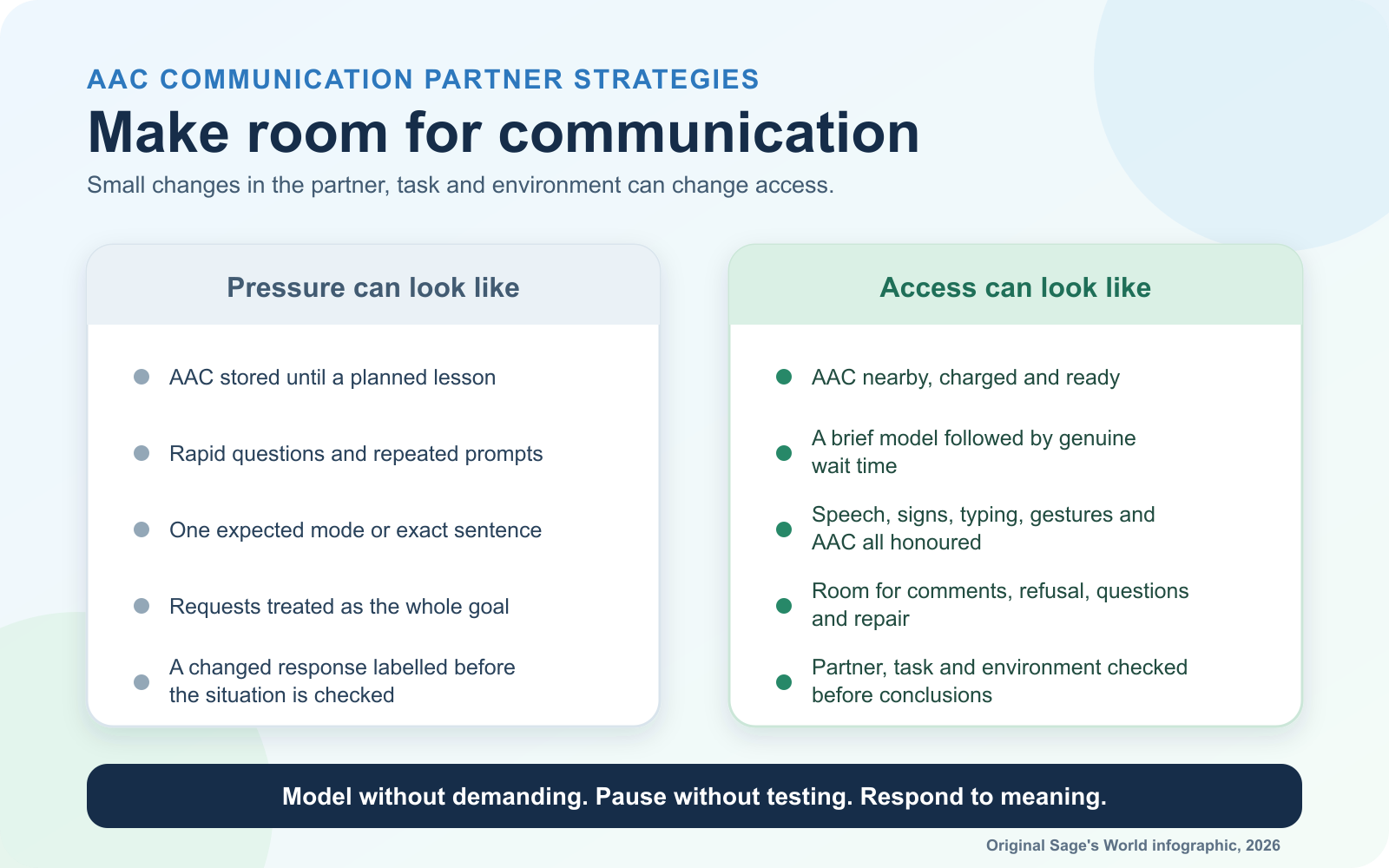
Comparison of AAC partner practices: keep AAC available, model briefly, honour every communication mode, support more than requests and check context before conclusions
Original Sage’s World infographic. Small partner changes can reduce pressure and create more room for communication.

Help the circle grow one low-pressure conversation at a time

Choose a predictable activity or topic the person already enjoys. Add one newer partner, not a crowd. Give that partner one adult habit to practise, such as modelling a useful comment or leaving more wait time. The familiar person can stay nearby without immediately answering or translating every turn.

Fictional example: During a familiar tabletop game, a peer learns where “my turn,” “again” and “funny” are located. The peer models one word, waits and responds when the learner first gestures and then selects “again.” The interaction succeeds because both people share the turn, not because a particular number of symbols is produced.

If AAC use changes with a new person, check access before drawing conclusions. Was the system present and working? Could the person reach or see it? Was the vocabulary available? Did the partner know how to wait and repair? Was the environment noisy, unfamiliar or physically difficult? The answer may vary by child, partner and day.

Describe adult AAC support clearly at school

Ontario’s Policy/Program Memorandum 81, updated in 2025, says the ongoing development and use of augmentative and alternative methods of communication in the educational setting must be part of the school program and a school-board responsibility, with the support arrangements described in the policy. Local roles, services and funding still vary.

The province’s IEP guidance lists communication aids and speech synthesizers among possible individualized equipment. The Ontario Human Rights Commission says education providers have a duty to accommodate disability-related needs, with individualized support and respect for dignity. This is general information, not legal advice. Ask the school board how current policy applies to a particular student.

Questions that make adult support more usable

  • Where must the communication system and approved backup be available?
  • Who knows the learner’s access method and essential operational steps?
  • Who provides staff training and follows up when staff change?
  • How will access continue during instruction, assessment, transitions, lunch, recess, clubs and emergency routines?
  • What should adults do during a communication breakdown?
  • How can the AAC user give feedback about the support?

For Ontario residents who meet its criteria, the provincial Assistive Devices Program communication-aids page explains coverage categories, assessment routes and current funding rules. Eligibility and payment arrangements can change, and school-owned equipment may follow different processes.

Observe the partner conditions, not only learner output

A short note can support problem-solving without turning communication into a score. Record whether the system was accessible and working, what the partner modelled or said, how much conversational room was provided, which communication modes the learner used, whether the message was acknowledged and what adult adjustment should be tried next. Keep observation separate from interpretation.

The earlier Sage’s World guide on tracking observable learning across settings offers a privacy-conscious note structure. For school planning, the Ontario IEP meeting checklist can help turn an access concern into a specific adult action and review point.

Protect communication privacy

A communication system may contain names, routines, health information, private vocabulary and message history. Follow the AAC user’s preferences and the organization’s approved process for backups, sharing and access. The Information and Privacy Commissioner of Ontario’s school guide provides general privacy and access information, but parts of its guidance are under review following 2026 legislative changes.

Keep names, diagnoses, school records, device backups, account details, contact information, identifiable photos and message histories out of general AI tools and drafts. A useful training handout can describe adult actions without copying private learner data.

AAC communication partner checklist

Before the conversation

  • The person’s AAC and approved backup are working and within access.
  • I know how the person communicates yes, no, stop, help and a need for a break.
  • I have a genuine activity or topic, not a quiz.
  • I know which system changes require the AAC user’s and qualified team’s input.

During the conversation

  • I address the person directly.
  • I model a small amount of useful language without requiring imitation.
  • I leave room for initiation and response.
  • I honour gesture, speech, signs, movement, writing and AAC.
  • I include comments, opinions, humour, refusal and questions, not only requests.
  • I acknowledge meaning before thinking about correctness.
  • I do not remove, withhold or take over the person’s system.

When meaning is unclear

  • I say that I may have misunderstood.
  • I offer more than one respectful repair route.
  • I keep the AAC user in control of the conversation.
  • I ask a familiar partner to help only when appropriate, while still addressing the AAC user.

Afterward

  • I note what the partner and environment did, not just what the learner produced.
  • I bring access, vocabulary, positioning or system concerns to the AAC user and qualified AAC team.

Where Sage’s World can fit, gently

Sage’s World is an educational and organizational tool, not an AAC system, therapy, diagnosis, formal assessment or a replacement for a speech-language pathologist. A family or educator might use a familiar visual choice or Talk Board during a Sage’s World learning activity when it fits the learner’s established supports. The person’s dedicated communication system should remain available.

If a team records a brief observation in Sage’s World, focus on the adult support and learning context. The educator page and Privacy & Data page explain the intended role and data controls. Do not upload communication profiles, device backups, school records, diagnoses, contact details or identifiable learner information to AI features.

One thing to do this week

Change one adult habit.

Choose one familiar activity. Keep AAC close, model one useful message, pause and respond to the person’s full communication. Notice what changed in the interaction, without demanding a result.

Sources and further reading

This guide was informed by the following authoritative and peer-reviewed resources. Current guidance, program details and links were checked August 4, 2026.

  1. American Speech-Language-Hearing Association, Augmentative and Alternative Communication Practice Portal
  2. American Speech-Language-Hearing Association, AAC in Early Intervention
  3. National Joint Committee, Communication Bill of Rights, Third Edition
  4. Royal College of Speech and Language Therapists, AAC Guidance
  5. Ontario Ministry of Education, Policy/Program Memorandum 81
  6. Ontario Ministry of Education, Components of the IEP Standards and Effective Practices
  7. Ontario Human Rights Commission, Policy on Accessible Education for Students with Disabilities
  8. Ontario Assistive Devices Program, Communication Aids
  9. Therrien and colleagues, 2025 systematic review of speech-generating-device interventions for autistic preschoolers

This article provides general educational information and lived perspective. It is not therapy, diagnosis, formal assessment, medical advice, legal advice or an individualized communication recommendation. AAC systems and access needs vary. Consult the AAC user, the school board’s current process and qualified professionals for advice about a particular child or teen.