
When an autistic child or teen becomes overwhelmed, adults may feel pressure to act quickly. Urgent action matters when safety is at risk. Otherwise, it may be more useful to lower demands, reduce incoming information and make communication easier.
The National Autistic Society describes a meltdown as an intense response to an overwhelming situation and distinguishes it from a tantrum. A meltdown is not a moral failing or a deliberate attempt to get a result. A person may cry, shout, move quickly, hit, bite, throw something, become very still or stop responding. The outward form does not tell us the full cause.
An autistic meltdown support plan cannot guarantee that distress will not happen. It can guide the next adult decision, protect communication access and coordinate support across settings. Every person and jurisdiction is different, and individual language preferences should be respected.
Start with what happened, not a story about why
Observation and interpretation are not the same. “Covered both ears, moved under the table and stopped answering spoken questions when the alarm sounded” is an observation. “Wanted attention” is an interpretation. The interpretation might be wrong, and acting on it can add pressure at the moment the person needs less.
Useful observations include the setting, sensory conditions, communication, recent changes, possible discomfort, adult actions and what the person did. They are not verdicts about character, intention or ability.
NICE guidance for autistic children and young people recommends considering communication access, physical conditions such as pain, mental health, lighting and noise, social settings, changes in routine and lack of predictability when distress affects participation or safety. That list is a prompt to investigate, not permission to guess.
Use a decision pathway when distress rises
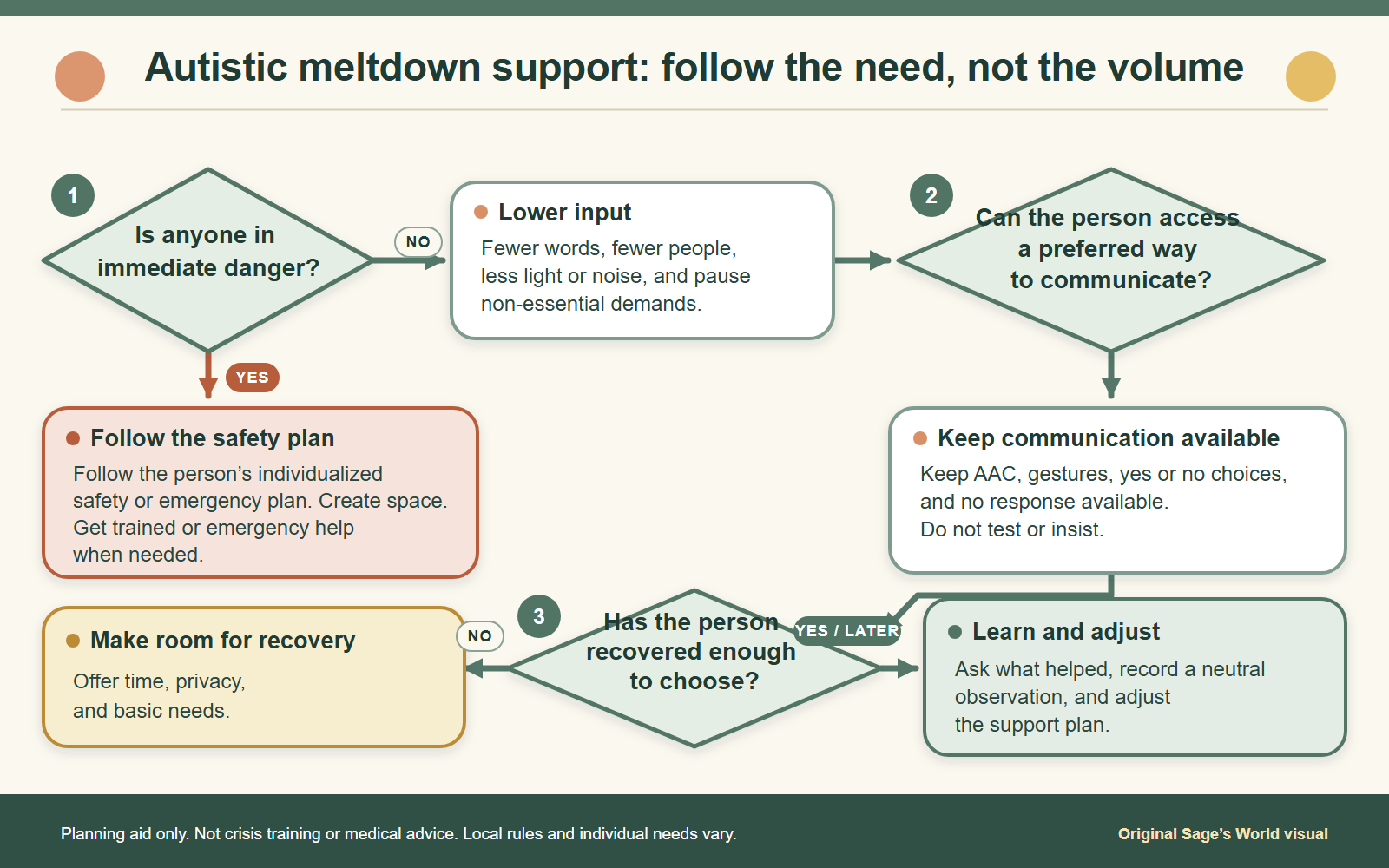
A plan is easier to use when it answers the question in front of the adult. Begin at the first question that fits. Move to another branch only when the situation changes.
Is anyone in immediate danger?
If there is immediate danger, serious injury or a life-threatening concern, use the setting’s emergency procedure and call emergency services when required. Safely clear hazards, move onlookers away and have one adult lead communication.
Do not use this article as instruction for physical intervention or improvise a hold. Follow the person’s qualified safety plan, current policy, local requirements and emergency-service directions. If the plan assigns roles, another adult can manage the surrounding space and bring established communication supports.
A safety response should protect dignity too. Avoid filming, public discussion or an audience. Explain necessary actions accessibly, even if the person cannot respond.
Can the person still signal a need or choice?
Keep an established AAC system, communication board, writing option or other familiar method available. Do not make speech the price of support. Offer a few useful options, but only when they are real and safe.
Short statements can be easier to process than repeated questions. “I am here. You do not have to answer” may create room. Silence, gesture, movement, typing, AAC, refusal and a delayed response can carry meaning. Regular supporters should know established signals for stop, break, help and pain.
Fictional example: In a school hallway, a learner drops a folder, presses both hands to their head and moves toward a quiet alcove. The educator stops asking about the next class, shows the learner’s familiar “quiet” card and keeps the communication device within reach. Another adult redirects passing students. The plan does not require the learner to explain the distress before the space is made accessible.
Is the environment adding more load?
Look for what can change around the person: noise, light, crowding, waiting, heat, an unexpected route, too much language or several adults giving directions. Reduce one source of load without making access something to earn.
Making space can mean dimming lights, lowering sound, pausing a task, moving people or giving more distance. Some people want a familiar adult nearby; others want distance. Record known preferences instead of using a universal script.
Fictional example: A teen at a community program begins pacing quickly when transportation is delayed and several people start offering solutions. The support worker asks the group to step back, writes “ride delayed, new time 4:20” on a familiar card and offers the usual waiting place. These changes may reduce incoming demands. They do not prove what caused the distress or promise a particular response.
Has the intensity begun to ease?
Recovery may take time. Keep demands low and continue accepted supports. Food, water, movement, quiet, a familiar interest or distance may be welcome or unwelcome depending on the person. Do not insist on eye contact, an apology, a lesson or an immediate return to the task.
Check for injury and practical needs without creating another interrogation. Let the person know what will happen next in a familiar form. When they are ready, offer control over who is present and whether any discussion happens now, later or through another communication route. The first goal is not to extract a reason. It is to support safety, access and recovery.
Fictional example: At home, a young person sits in a dim room after a loud kitchen appliance is turned off. A caregiver leaves water nearby, says that dinner can wait and stops asking questions. Later, the young person types that the sound hurt. The delayed message adds useful context without turning it into the only possible explanation.
Is the pattern sudden, severe or changing?
A new or marked change deserves attention beyond the immediate setting. Pain, illness, sleep disruption, medication effects, anxiety, bullying and other health or life changes can affect distress. The Canadian Paediatric Society notes that communication differences can make health concerns present in less familiar ways and recommends individualized, coordinated follow-up for coexisting conditions.
Seek qualified medical advice when pain, illness, injury or another health change may be involved. Use emergency services for an urgent concern. If episodes are changing, ask the qualified team to review communication, health, sensory access, environment and support together. An app log or school note cannot diagnose the cause.
A practical autistic meltdown support plan checklist
A useful plan is short enough to find under pressure. Develop it with the child or teen through their preferred communication, together with the family and qualified team. Within its scope for children up to age 12, Autism CRC’s supporting children guideline emphasizes partnership, individualization, human rights, coordination and accessible environments.
Include:
- Early signals: only observable signs the person and team recognize, such as covering ears, becoming very still, repeating a question or moving away.
- Communication access: how the person communicates stop, help, pain, no, space and finished, plus the approved backup method.
- Accepted adjustments: changes to sound, light, language, space, timing, tasks or people that the person prefers.
- Safety threshold: what counts as immediate danger and which local emergency procedure applies.
- Adult roles: who leads, who clears the space, who contacts the designated person and who supports everyone else.
- Recovery preferences: what to offer, what to avoid and how the person indicates readiness for the next step.
- Review trigger: when a change, injury, health concern or repeated pattern requires team or clinical review.
A role matrix for home, school and community
| Setting | Lead responsibility | Useful handoff |
|---|---|---|
| Home | Reduce household demands, manage hazards and keep familiar communication available. | Share the minimum useful observation and any health concern with the next authorized adult. |
| School | Use the student’s current accommodation and safety processes, protect privacy and identify who covers the class or space. | Record what was observed, which supports were available and what needs review, using the board’s approved channel. |
| Respite or community | Know the venue, exit and emergency process, reduce the audience and contact the named family or program lead. | Report concrete conditions and actions, not a judgment about motive. |
At school, the plan must fit current provincial, board and workplace requirements. Autism CRC’s inclusive education guidance centres wellbeing, belonging, collaboration and supportive environments. The Ontario Human Rights Commission’s education policy centres individualized accommodation, dignity, inclusion and privacy. This is not legal advice; ask how current policy applies locally.
Review the conditions, not the person’s character
Ask what was observed, what changed, which communication was available, which adult actions reduced or added load, whether health follow-up is needed and what the child or teen wants adults to understand. They may contribute later through speech, AAC, typing, drawing, choices or declining discussion.
Change one part of the plan at a time when possible, then keep observing. The aim is not to create a score or demand that the person tolerate more. It is to make the environment and adult response more accessible. The earlier Sage’s World guide on tracking learning across settings offers a simple way to separate what happened from what adults think it meant.
Keep the plan private and usable
A support plan may contain health, communication and safety information. Share only what an authorized person needs for their role. Use approved school, health or agency systems, not an informal group chat. The Information and Privacy Commissioner of Ontario’s education hub explains that Ontario school boards must follow privacy and access rules for student information. Its detailed school guidance is under review after 2026 amendments, so confirm the current board process. Requirements vary by setting and jurisdiction.
Keep names, diagnoses, school records, contact details, identifiable photos and event records out of general AI tools and drafts. Ask the child or teen what is written and who receives it in an accessible way. A plan should support the person, not label them.
Where Sage’s World can fit, gently
Sage’s World is an educational and organizational tool, not therapy, diagnosis, formal assessment, medical or legal advice, an emergency service or a replacement for professionals. In a calm planning moment, familiar words, a visual schedule or a social story might make a routine clearer. Established AAC should remain available.
If an adult records an observation, keep it short: what happened, what support was available and what the team should review. Do not use a Sage’s World activity during a meltdown as a demand to calm down or prove a skill. The How It Works page explains the app’s goal, practice and observation role, while Privacy & Data describes family controls and optional services. Core learning does not require AI.
Begin with the decision your team cannot yet answer. Who leads when danger is possible? How does the person ask for space? Which change is usually accepted? Confirm the plain-language answer with the person and team, then keep it accessible to authorized adults.
Sources and Further Reading
- NICE, Autism spectrum disorder in under 19s: support and management, including the current recommendations
- Canadian Paediatric Society, Post-diagnostic management and follow-up care for autism spectrum disorder
- Autism CRC, National Guideline for supporting the learning, participation and wellbeing of autistic children and their families
- Autism CRC, National Guidance for best practice in inclusive education for autistic students
- National Autistic Society, Meltdowns: a guide for all audiences
- Ontario Human Rights Commission, Policy on accessible education for students with disabilities
- Information and Privacy Commissioner of Ontario, A Guide to Privacy and Access to Information in Ontario Schools
Sources and time-sensitive guidance were checked August 15, 2026.
General-information disclaimer: This article provides general educational information and lived perspective. It is not therapy, diagnosis, formal assessment, medical advice, legal advice, emergency instruction or an individualized support plan. Needs, risks, policies and services vary by person, setting and jurisdiction. Work with the autistic child or teen, family, school or organization, and qualified professionals. Call local emergency services for immediate danger or a life-threatening concern.