When a child or teen leaves a safe place or responsible adult and cannot be located, the situation can become urgent very quickly. A written plan cannot remove every risk. It can reduce guesswork, make handoffs clearer and help adults respond from the same information.
Official sources often call this wandering or elopement. This guide uses wandering or going missing because those words describe the safety situation without assuming why it happened. Not every autistic person wanders. For someone who does, the circumstances, communication, interests, sensory needs and level of danger vary.
This is general educational information, not an individualized safety assessment, medical advice or legal advice. Emergency procedures, school processes, privacy rules, fire requirements and local programs vary by jurisdiction. Work with the child or teen, family, school, service organization, qualified professionals and local emergency services as appropriate.
Start with observation, not a story about motive
A useful plan begins with what people have actually noticed. Write: “At 2:10 during a noisy hallway transition, moved quickly toward the north exit.” That is an observation. “Was trying to avoid work” is an interpretation. It may be worth exploring, but it should not be presented as fact.
The U.S. Centers for Disease Control and Prevention notes several reported reasons for wandering, including reaching an interesting place, exploring or leaving noise or stress. For one learner, a door may lead toward water. For another, leaving may begin when a familiar routine changes. For a teen, planned movement, conflict or a wish for privacy may be different from becoming lost. Ask, listen and observe using every communication form available.
A short record can include the setting, time, transition, nearby exits, what the person did, what support was available and what happened next. Look for patterns, but keep possible explanations labelled as possibilities. A context-rich observation is more useful than a label.
Build four layers instead of trusting one tool
No alarm, lock, identification card, registry, GPS device or teaching approach can guarantee safety. The stronger plan uses several layers that fit the individual and setting.
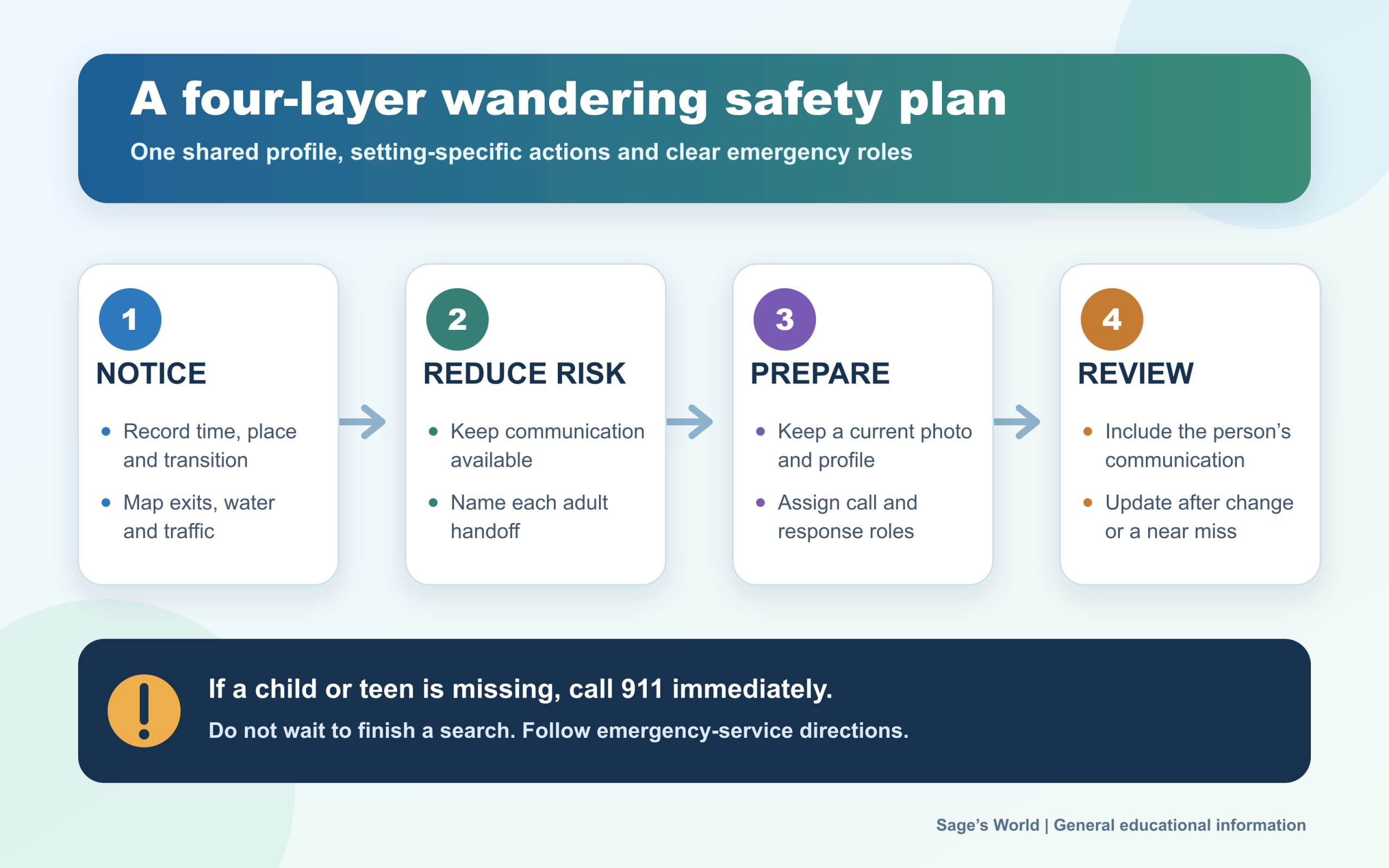
1. Notice
Map observed patterns, transition points, favourite places, exits and nearby hazards. Include strengths, communication and what helps the person feel oriented.
2. Reduce risk
Clarify adult roles, make routines understandable, support access to communication and check the environment before activities begin.
3. Prepare
Keep a current photo, description, response steps and the minimum useful information ready for trusted adults and responders.
4. Review
After a near miss, change or scheduled check-in, update the plan with the person and team. Keep what helps and revise what does not.
The aim is safe participation, not shrinking the person’s world. The Autism CRC national guideline emphasizes individualized supports, involving autistic children in decisions in ways that fit their communication and understanding, and considering the child and family context. A good safety layer should preserve dignity, access and growing autonomy as much as possible.